This striking 19th-century French monstrance is an wonderful example of ecclesiastical metalwork, featuring a solid silver upper half—fully hallmarked and acid-tested—and a silvered bronze architectural base. Designed for the display of the consecrated host, the piece combines devotional symbolism with the technical precision characteristic of French liturgical objects from the mid-to-late 1800s.
⭐ Materials & Construction
Solid Silver Upper Half
The radiating sunburst, housing ring, and cross finial are crafted in solid silver, confirmed by:
The silver surfaces retain a beautiful soft patination, adding depth without obscuring detail.
Silvered Bronze Base
The lower half—including the stepped plinth, column, and paw-foot supports—is made of finely cast bronze, finished with a thick silver-plated surface. The casting quality is crisp, and the plating remains mostly intact with subtle age wear.
⭐ Design Details
Radiant Sunburst Gloria
The circular glory is formed from layered silver rays, alternating in length to create dramatic depth and light refraction.
Cloud and Scrollwork Cartouche
The central node below the glass window features raised swirling cloud motifs, a symbol of divine presence.
Symbolic Base with Agnus Dei
The front of the plinth is decorated with a deeply cast Agnus Dei—the Lamb of God—surrounded by sunburst rays, representing sacrifice and redemption.
Architectural Plinth & Paw Feet
Tiered square base with floral cartouches
Engraved foliate scrolls
Bold lion-paw feet with exceptional modeling
Stable and substantial, ensuring proper altar presence
⭐ Dimensions
19”H x 7”W x 4.5”D
⭐ Condition
Silver upper section: good condition with light expected patina
Glass reliquary door: opens and closes properly
Silvered bronze base: minor wear to plating consistent with age
structurally sound and well-balanced
No major dents, splits, or losses
An impressively preserved example for its age. The monstrance dates approximately to the mid-19th century, likely circa 1850–1880, produced in a French ecclesiastical metalworking atelier serving regional churches.
Total Weight of item: 1,441 grams
This striking 19th-century French monstrance is an wonderful example of ecclesiastical metalwork, featuring a solid silver upper half—fully hallmarked and acid-tested—and a silvered bronze architectural base. Designed for the display of the consecrated host, the piece combines devotional symbolism with the technical precision characteristic of French liturgical objects from the mid-to-late 1800s.
⭐ Materials & Construction
Solid Silver Upper Half
The radiating sunburst, housing ring, and cross finial are crafted in solid silver, confirmed by:
The silver surfaces retain a beautiful soft patination, adding depth without obscuring detail.
Silvered Bronze Base
The lower half—including the stepped plinth, column, and paw-foot supports—is made of finely cast bronze, finished with a thick silver-plated surface. The casting quality is crisp, and the plating remains mostly intact with subtle age wear.
⭐ Design Details
Radiant Sunburst Gloria
The circular glory is formed from layered silver rays, alternating in length to create dramatic depth and light refraction.
Cloud and Scrollwork Cartouche
The central node below the glass window features raised swirling cloud motifs, a symbol of divine presence.
Symbolic Base with Agnus Dei
The front of the plinth is decorated with a deeply cast Agnus Dei—the Lamb of God—surrounded by sunburst rays, representing sacrifice and redemption.
Architectural Plinth & Paw Feet
Tiered square base with floral cartouches
Engraved foliate scrolls
Bold lion-paw feet with exceptional modeling
Stable and substantial, ensuring proper altar presence
⭐ Dimensions
19”H x 7”W x 4.5”D
⭐ Condition
Silver upper section: good condition with light expected patina
Glass reliquary door: opens and closes properly
Silvered bronze base: minor wear to plating consistent with age
structurally sound and well-balanced
No major dents, splits, or losses
An impressively preserved example for its age. The monstrance dates approximately to the mid-19th century, likely circa 1850–1880, produced in a French ecclesiastical metalworking atelier serving regional churches.
Total Weight of item: 1,441 grams


 Image 1 of 14
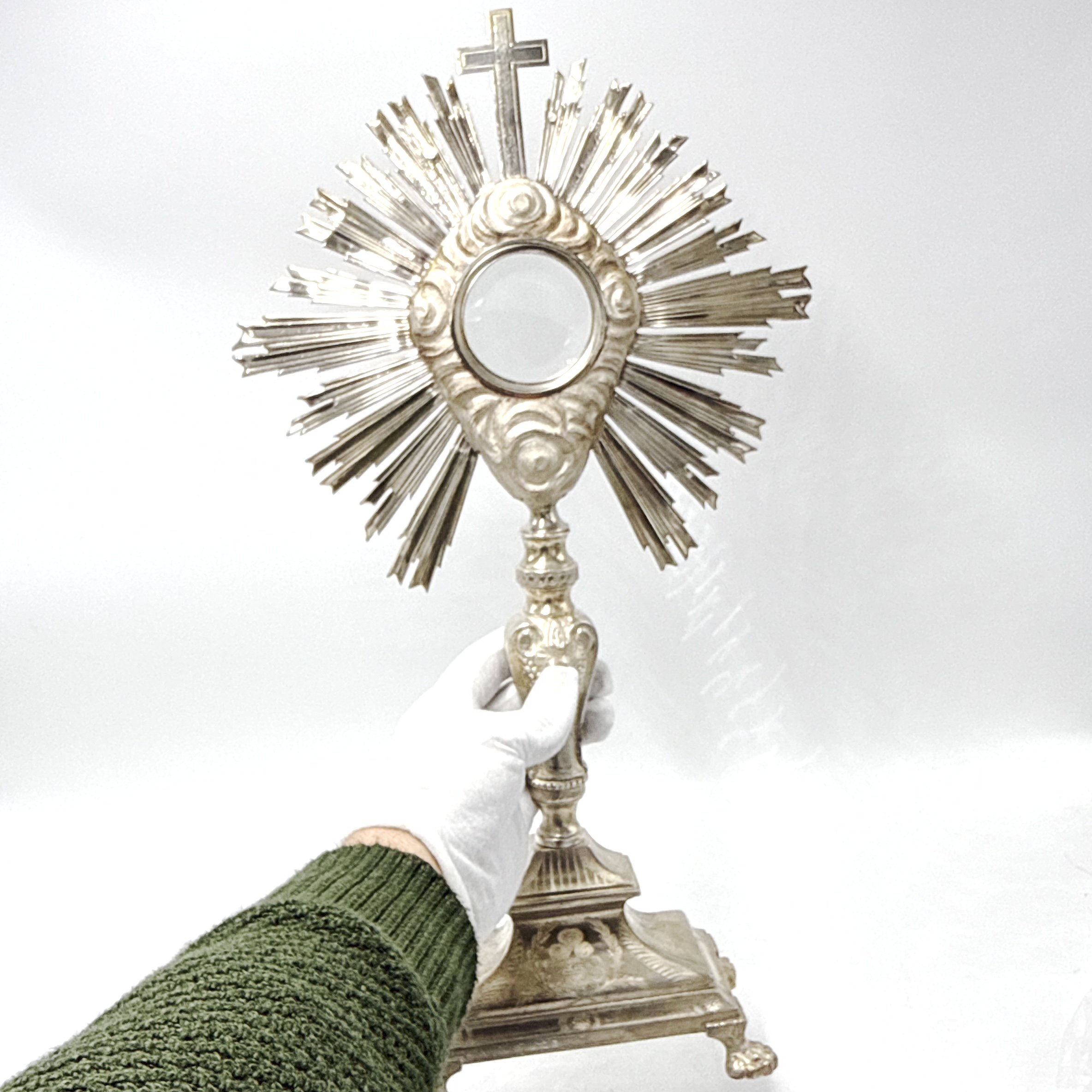 Image 2 of 14
 Image 3 of 14
 Image 4 of 14
 Image 5 of 14
 Image 6 of 14
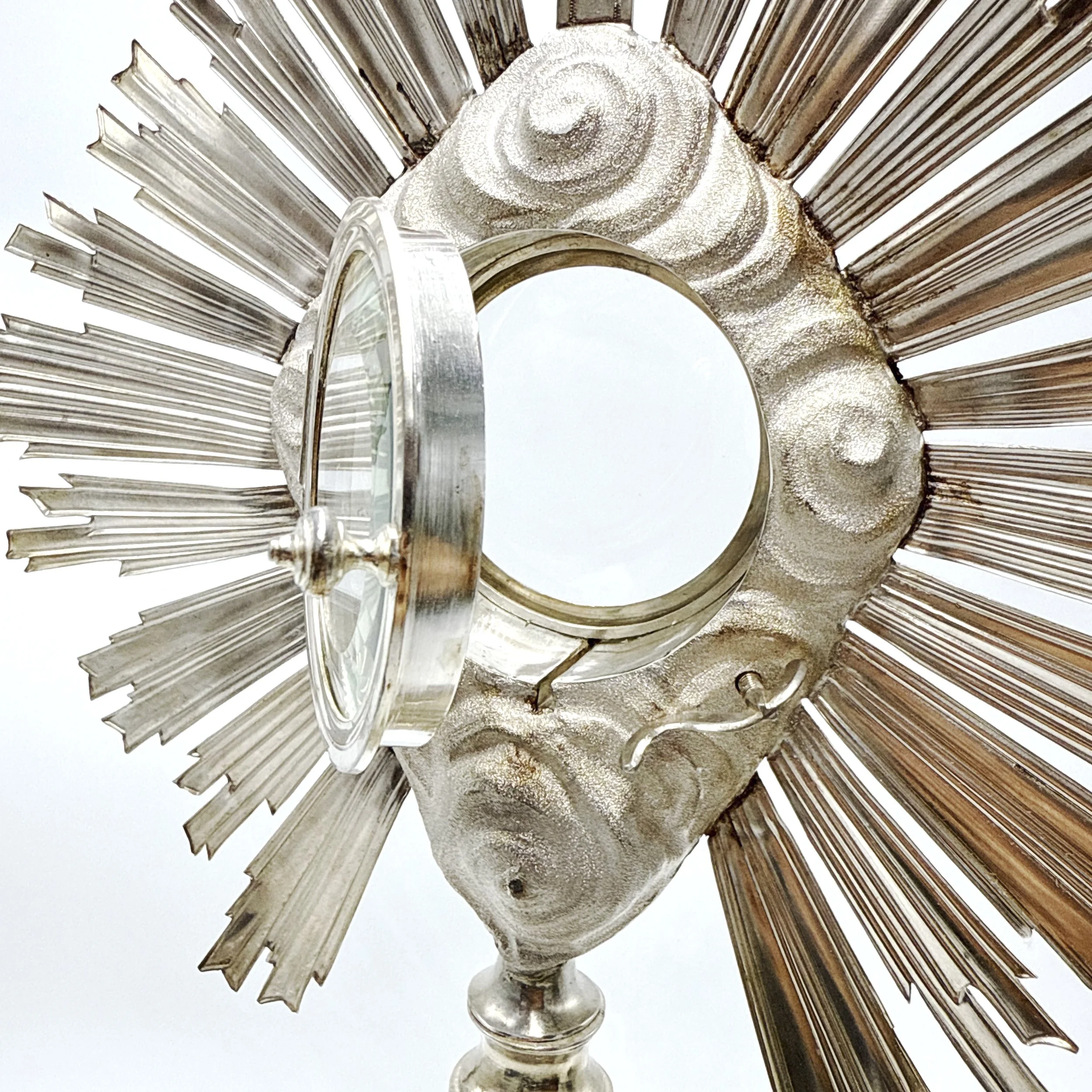 Image 7 of 14
 Image 8 of 14
 Image 9 of 14
 Image 10 of 14
 Image 11 of 14
 Image 12 of 14
 Image 13 of 14
 Image 14 of 14